Showing posts with label the industrial revolution. Show all posts

Wednesday, 15 March 2017

Child Labour

Many people believe that it was the government that put an end to child labour in Western Nations but in fact almost all the children in Britain were already in school when child labour was banned. Likewise, child labor laws in the US were passed only after around 90% of the child labor had been eliminated anyway. A large part of the push for these laws came from labour unions who wanted to increase wages by reducing competition from younger workers, and as the business community was not particularly dependent on child labour any more it had no reason to lead a counter charge.

It actually requires an advanced economy to ban children from working. Children had worked throughout all of history, long before the onset of the industrial revolution had them conspicuously running around factories. It was a given fact of life because every pair of hands was needed to provide for a family, so they worked on the farm. As soon as Western economies were rich enough that parents could provide for their children without sending them to work they sent them to school instead. In the mind-nineteenth century before there was any mandatory education in the UK, 95% of children in Great Britain already had at least 5 and often as many as 7 years of education.

Further empirical evidence was recently provided, all to sadly, in Bangladesh where they tried to ban child labour prematurely only to find (as Oxfam reported) that the results were horrific. The kids went into prostitution, destitution, begging, stealing and starvation.
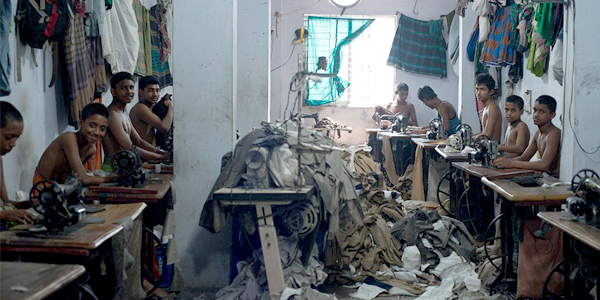
Image result for child labour in factories

It appears that every society naturally takes children out the workplace when they are rich enough. It's not that parents, all throughout history, hated their children! They sent them to work because there was no viable alternative.

As world poverty continues to decline, things are going in the right direction. Child labour has declined by one third since 2000, from 246 million to 168 million children. It's not that we can do nothing in western nations to speed along this process either, in fact - with the political will - we can. Charity can help, but the primary necessity is to open up free trade with the poorest countries in the world. Removing trade barriers to buying their products would help lift millions out of poverty abroad and lower the cost of living for families on low incomes at home. The next step would be to use our influence to encourage those countries to open up their economies to foreign investment so that companies from all over the world would flood in, bringing technology, skills, and infrastructure while bidding up the price of wages. As adults are able to earn increasingly more they will be able to take their children out of work and into education where they belong.

A. S. 04-03-17

If you liked this article you may also learn from this related article on workplace safety.

Saturday, 24 December 2016

Why The State will Not solve Social Problems

The impulse of the state is not to solve social problems but to create as many dependents as possible, including a bloated public sector full of Marxists and as many people as possible on welfare who they can then turn on whenever they need someone to blame for their own excesses. That is why the size of government grew massively even under so-called free market Thatcher who made hand-outs to big business and sent military spending through the roof. Every dependent will make justifications for the existence of the state as a necessary evil and attack the free market which takes people out of poverty. The natural state of everyone who is born is poverty; all wealth was created by individuals for themselves or to trade with other people for something which they agree upon in a voluntary exchange. Voluntary exchange enriches both parties as each trader values what they get from the trade more than what they part with, and so trade takes people out of poverty not government. Government retards this organic process by putting restrictions on who can trade with whom under what circumstances and passing an ever increasing litany of laws that make it impossible for poor people to find employment so that many people will have to compete for few jobs and accept whatever conditions are given to them. This creates dependency upon which government survives. To complete the trick the government directs the attention of the oppressed to their crappy bosses rather than the conditions which created the crappy bosses, those state interventions which restricted the number of jobs.

The government cannot solve social problems because the government lives on social problems. If tomorrow everyone woke up in a world without crime then what need for a large police force? In a world with little poverty and many routes out of poverty, then what need for huge welfare programs and government bureaucrats to administer them? If there wasn't a shortage of medical staff pushing the price of medical care through the roof then who would tolerate a million people on NHS waiting lists? If we didn't fear any enemies in the Middle East or Russia what need for a large military and curtailments on civil liberties? Who would need government without social problems? Who would want it? It is in the interests of government to perpetuate social problems internally and create enemies abroad, then blame all of this on capitalism and the free market so the average individual will call on government to save them.


If we want to solve social problems we need to dig in with our own hands and start helping. We can volunteer, create organisations, or support organisations that are already doing good work. 

Wednesday, 21 December 2016

Workplace Safety

It's widely believed that it was the intervention of government and labour unions which is responsible for improving safety conditions in factories and other industries, but that is not accurate. This graph demonstrates that workplace fatalities were already very much on the decline before OSHA (the Occupational Safety and Health Administration) was even founded in America:

Effect of OSHA work workplace fatalities:

Tom DiLorenzo wrote in Capitalism "Enriches the Working Class":
"Capitalism has also made the workplace safer. In relatively “dangerous,” strenuous, or dirty jobs, employers must pay a wage premium because relatively few people want such jobs. Economists call this a “compensating difference.” The man who rides on the outside of the garbage truck at daybreak, in the winter, in the northern states, does so because he makes a very good salary – better than any of his alternatives. Profit-seeking capitalists have always understood that they need to pay more to get people to perform risky or dangerous work. Therefore, they have also always understood that there is profit in making the work place safer. A safer workplace requires a lesser compensating difference. Lower wages paid to the workers can mean higher profits for the capitalist. Thus, the American workplace had become safer and safer for generations before the Occupational Safety and Health Administration (OSHA) was established in the 1970s. Indeed, OSHA has often reduced workplace safety with its clumsy and stupid workplace rules enforced by government bureaucrats with no knowledge of the specific work that they are regulating. "

The government can intervene to bring about workplace safety faster, but this will not be without any negative consequences to their employees. The dictates of government will displace private efforts. Once the state declares that they are in charge of safety businesspersons are going to leave it up to the experts. Rather than investigating what investments will improve safety most effectively, they will spend lots of money on whatever the central planners at OSHA dictate; and if these are harebrained ideas these resources will be misallocated and go completely to waste.

Do you really think those workplace safety advancements were paid for out of the factory owners pockets? Well they weren't. They were paid for out of the workers pockets. Employers have a certain amount to budget for labour and it makes zero difference to them whatsoever if that gets spent on wages, health and safety, health insurance, company cars or anything else the employees might want to receive as payment in kind. On a free market employees will tend to get roughly the package of spending on them that they want because if a workplace is too dangerous they can go somewhere across the road that pays them less and spends more on safety. As recent empirical evidence of this the economist Benjamin Powell actually went to factories in the poorest countries in the world and asked them if they would like better health and safety, shorter hours, and a long list other benefits; overwhelmingly they said yes to everything - who wouldn't? - Unless those benefits meant less pay. In which case they declined them all. This is why workplace safety was shoddy when people were poor, but improved as people got richer. When you're broke you'd rather your employer spent the money on your wage than health and safety. However, as your standard of living increases safety at work becomes more of a priority so your expectations on your employer go up. This would all arranged voluntarily even without legislation from government. In fact it was! If employers were responsible for injuries or deaths they may have been sued for damage in common law courts for having caused harm or loss.

The best defense of workers rights is having the largest choice of employers available as possible. All of the things which the left think will help workers reduces their number of options by making employing people profitable to less employers and therefore reducing the options of workers rather than increasing them. The consequence of having less jobs to go around is that low skilled workers have to accept whatever is going on whatever terms are offered to them, and often tolerate crappy bosses. On a free market, some people might have to tolerate a less well paid job in the short term, but if they have a bad boss or do not like the safety conditions at work they can easily walk into a job elsewhere because anyone can employ them. This is a system of spiritual advancement. A wise individual can choose the job that will teach them the most skills, then move to the next one, and onto the next, and keep on moving from job to job gathering skills until they can get a management position, start their own business, or become a staff trainer or consultant themselves. It affords the maximum opportunity for class mobility. Each well-intentioned socialist policy: the minimum wage, maximum regulations, workplace safety, - takes a big slice out of the pie of possible jobs available and reduces the prospects of the poor to become wealthy in the long term.

Monday, 19 December 2016

Government is a Trojan Horse for Environmental Destruction

For all its faults one thing the Government does is protect the environment from profit-seeking corporations, right? Without government to stop them,corporations would just lay waste to the environment in pursuit of the bottom line. That's the popular view.

An investigation of history might yield some surprises.

There was a time where the courts ruled by common law and were held separately and above the government. When an industrialist polluted  a stream or the air in a way that caused physical or financial harm to his neighbors, the courts would force them to pay reparations and a penalty. This in itself did a pretty good job of deterring people from polluting,

Until the latter part of the nineteenth century this form of law, where the right of every individual were considered, was successful, it stated that if you caused harm or law to another person it was your duty to restore them to their original condition and compensate them. Then, as documented by Morton J. Horowitz in his two-volume treatise named The Transformation of American Law, the legal system began to change. Industrialists went to the government to have it changed.to a more collectivist philosophy where lawyers and law makers became increasingly concerned with what was termed “the common good."

"Under the individualist view the law should protect everyone's right to life, liberty and property – which includes the right not to have your body or property damaged by the pollution of others. The new legal system however argued that no individual or group of individuals should stand in the way of the economic progress of the entire community. Therefore a few victims of pollution should not interfere with economic development prospects that would benefit "The greater good.”" (Tom Dilorenzo)

The government came back and told the people that while the factories were polluting and there would be some victims the industry served 'the common good' and therefore people just had to accept the pollution as a fact of life 'in the greater interests of society as a whole' and all those high minded phrases the left have since appropriated. When you consider history you will see that it is government that made the way for industry inflicting damage on others.