Showing posts with label anarchism. Show all posts

Wednesday, 28 November 2018

Snow

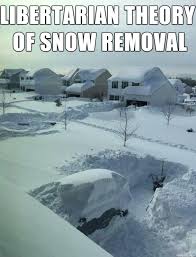
I remember seeing this cute little meme posted, without irony, on facebook a couple years ago.
Related image

Clearly the fact that the picture highlighted the failure of a state program escaped the OP.

More seriously though, it's hard to see how the removal of snow would pose any problem for the private sector at all. Some entrepreneur (or community serviceman reprisenting a nonprofit organisation) comes round the neighbourhood and asks if people are willing to contribute however much (or little) would be necessary to insure them against heavy snows. If necesseary, the organisation could draft a contract which says if the necessary amount of people to fund the program is not reached, the people who agree do not have to pay.

Everyone who does pay up gets placed on a register, and gets a nice big siver snow-flake medallion to put on their mailbox or gate to show off to their neighbours that they have contributed. If some people can't afford to pay they can be offered a discount rate, or perhaps they could be included on register in return for agreeing to volunteer for the snow removers should their help ever be needed.

If people choose not to buy into the system, when the snow falls eventually come, the company will drive by houses that are not on their register and don't have a snow medallion on display, or they will bill them out of pocket for a far larger sum than the original insurance fee to clear their driveway, offsetting the costs for everyone else. Perhaps they will think better in future. Even so, they will not necessarily be stranded - they can pay the neighbours children to take shovels and clear it like in the old days.

Problem solved.

Similar arrangements could be made for other services considered "public goods", like municipal garbage removal. For things like street lighting, which are near impossible to exclude those who do not pay for provision of, the medallion system would allow neighbours to apply social pressure to free riders without applying the use of coercion to subtract funds. Those who don't have theirs on display might attract disapproving looks, or have people round saying, "hey man, you are taking money out of everyone's pocket, when everyone pays, everyone pays less." With the technology we have today, it would be easier than ever to apply pressure to those who shirked the responsibility of sharing in the costs of local services they benefit from. The local shop could choose not to serve them and they may need to drive further to the supermarket which will not be worth the hassel of not buying a medallion. Their neighbours could choose not to allow them to collectively buy other services unless they paid in, meaning they would have to make their own arrangements which would prove costlier than choosing not to cooperate.

Tuesday, 4 April 2017

The River: Public Policy or Private Responsibility?

What is common to many is least taken care of, for all men have
greater regard for what is their own than what they possess in
common with others. 
—Aristotle
The idea of aspects of the natural world being "privately owned" strikes as rather crass to most people and perhaps with some good reason as it brings to mind a vision of heartless mercenaries sacrificing nature to the pursuit of profit. Industrialists, we are led to believe, can only possibly view nature as a means to and end rather than an end in itself, and in doing so reduce it to a disposable commodity.

However, this prevailing assessment does not take into the equation the fact that true ownership is attended by responsibilities to which an owner must be held accountable. Where rights entail responsibilities (as they have in the past under common law), and these responsibilities are enforced, the claim to a property will serve naturally as an incentive to conserve that property. In effect owners will become custodians.*

* (The words "ownership" and "property" have perhaps simply taken on negative connotations synonymous with exploitation for various historical reasons, and so it is essential in order to dialogue on these topics that we make explicit the fact that our definition of ownership is one that not only entails property rights but property responsibilities.)

Most people presume that government must fulfill the role of protecting the natural world, but this arrangement throws up some rather dubious incentives. When governments write policy documents about rivers, lets say, they tend to be for the purpose of  delineating who is allowed to exploit the river, on what terms, and in what measure. Special favours can always be handed out to cronies or campaign contributors; to “stimulate local business”; or for any other political ends that might attract short term support for office-holders regardless of the long term consequences. The rights to log a forest can be sold off to the highest bidder and the tax payer can be left with the burden of restoring it to health.


Where the river (or forest) has particular ownership (rather than general ownership) it is fully in the interests of the owner (or owners) to keep it permanently in pristine condition for at least three reasons. (Owners also need not necessarily be private companies or individuals, but also charities, trusts, worker or consumer cooperatives, NGOs, or any form of organisation - that notwithstanding,  even if held by a private corporations these same incentives will apply.)


The first is in order to retain (or even increase) the resale value of the river. The better condition the river is kept in the higher its value will become; and even if the proprietor has no plans of ever selling the river they still have no interest in losing whatever outlay they have sunk into acquiring it in the first place. As such, a particular owner has the maximum incentive to protect against the river being polluted and to take whatever action is necessary to prevent it from being polluted. As a rightful owner they have the legal and moral right to take action against anyone who pollutes the river because the polluter has damaged the value of their property.  As it is not under general ownership where everyone has as much right to abuse it as anyone else does, the proprietor's interests are aligned with the interests of the natural world, thus he is risen to the level of a custodian. 

Secondly, a well-kept resource is renewable - it can turn a profit indefinitely. A badly-kept resource cannot. If a river is ill-kept the return on the investment for acquiring that resource will soon dry up (no pun intended.) As such an owner who does not know how to take care of the river will stand to gain more from passing it on to someone who does than from keeping it. A superior custodian will be able to pay more to acquire the river since they know how to put it to good use indefinitely.  The best experts in keeping a river running cleanly stand to gain the most from owning them and therefore will be able to pay more to acquire them than those who lack that expertise. In this way those who are the best custodians of resources will end up with them in their care on average over time. (The same would go for forests, fisheries, or grazing lands; where altruism is not enough to motivate environmental concern, rational self-interest will usually do the trick.)

Thirdly, if the river is not properly kept and becomes polluted, this is inevitably going to have negative effects on neighbouring lands, industries and settlements as the pollution is carried by the river onto other people’s property. At this point, as the last line of defence against irresponsible misuse and management of the river is the threat of litigation against the owner for his negligent and harmful management of his property. Where others have suffered harm, loss of health, or damage to their own property, a particular owner should be forced to pay damages and reparations to restore them to their original condition. They can lose their personal property and have to forfeit ownership of the river if they are found guilty of causing damages. When the government causes environmental catastrophes, as they often have, they can only be tried in their own courts, and even so the property of decision-makers is never at stake - even if found guilty of wrong-doing, the public purse will eventually foot the bill. As officials in public institutions tend to have a diffusion of responsibility it is hard to hold particular culprits to account for their actions, rarely will a department be shut down or replaced where abuses occur as they are presumed essential even having "made mistakes". Often state officials have sovereign immunity, occasionally one or two resignations will be tendered as a  token gesture, but the machinery of the institution remains as well as the lack of moral hazard which set it up to fail.

Sunday, 12 March 2017

Why is the Capitalist Workplace so Authoritarian?

You are told that capital tyrannizes over labor. I do not deny that each one endeavors to draw the greatest possible advantage from his situation; but, in this sense, he realizes only that which is possible. Now, it is never more possible for capitalists to tyrannize over labor, than when they are scarce; for then it is they who make the law -- it is they who regulate the rate of sale. Never is this tyranny more impossible to them, than when they are abundant; for, in that case, it is labor which has the command.
- Frederic Bastiat, from Capital and Interest

A persistent criticism of capitalism as an ideology is that it is authoritarian by nature, and can only lead to tyrannical bosses ruling over dependent staff who are forced - by fear of poverty and starvation - to remain under their command. Certainly, if we take our example from the workplaces of today, most of them are hierarchical, and many of them pretty authoritarian. In extreme cases staff even need to ask permission to go to the bathroom. So there appears to be some demonstration to the thesis.

In reality there is nothing inherent in the system of free enterprise that necessitates hierarchy, and many businesses have been successfully run with decentralised structures. Ricardo Semler is an example of an entrepreneur who had such massive success running his business on a non-hierarchical model that he turned to teaching other capitalists all over the world to do the same. Nonetheless, crappy bosses who like to throw their weight around the shop or office are ten a penny, and since no one likes working under a dictatorship we really have to question why more egalitarian models not more common.

A market will tend to use the skills and propensities of the labour force within that market, because it is costly and time consuming to inculcate staff with new habits. For example, if a workplace can afford to hire experienced staff rather than train newbies they will often do so (especially where there is a high minimum wage.) Companies will sooner offer a raise to hold on to an employee with a good work ethic than take a risk on someone new. The fact is, human qualities are less malleable than other factors of production, and so it's usually going to be preferable to try and court the kind of employees you want around rather than try to foster whoever walks in the door into a new sort of character you like; especially considering people have their own proclivities and desires for their own personal character development, unlike machines. This is why most of the companies that run in cooperative or non-hierarchical structures begin with this idea as a primary value, and will tend to attract a certain kind of person who shares in the company vision and is competent to contribute to making it a reality. (Tim Kelley, an expert who currently helps companies adapt to what he calls "The New Paradigm in Business" states that as they do usually some number of employees flee, unable to adapt to the rights they are afforded, and responsibilities they must shoulder, under the changed system.)


Now am I saying that people are naturally slavish and therefore will tend towards hierarchy on a free market?

Not at all!

The average person who enters the workplace has been through 11-13 years of a mandatory education system which is highly authoritarian and hierarchical, and at the time in their life where their character is most impressionable and inclined to adapt to their circumstances. Their personalities have already been adapted to what was necessary for them thrive (or at least survive) under that system. Interestingly, the empirical evidence on how people best learn seems to suggest that a cooperative learning environment is far more productive than the isolated one that is the dish of the day at school. A crappy boss is not that unfamiliar in aspect from a crappy teacher, and it's hard to imagine that a population exposed to a long period of cooperative and mutually edifying education along the lines of the empirical evidence would be so tolerant of poor treatment from authority. If schools were to teach reasoning, social skills, emotional handing, conflict resolution, and other soft skills, far more people would have the skills to run organisations. start business enterprises, or create egalitarian ones.

The Marxist ideal of workers owning the means of production is perfectly compatible with free market capitalism, and there is no reason why there should not be more worker run cooperatives, communally owned business, and organisations with polycentric structures - other than the fact that currently, workers have no idea how to own the means of production or run a business. Partly because this requires different skills from what is required to complete their jobs from day to day, and partly because they are pre-conditions by years of hierarchical and authoritarian state education. If Marx was right and bosses provide no value - only skimming profit off the top - then workplaces without bosses will surely be more efficient and out-compete workplaces that shell out unnecessarily on paying them... but we will never know until we reform our education system.


Saturday, 24 December 2016

Why The State will Not solve Social Problems

The impulse of the state is not to solve social problems but to create as many dependents as possible, including a bloated public sector full of Marxists and as many people as possible on welfare who they can then turn on whenever they need someone to blame for their own excesses. That is why the size of government grew massively even under so-called free market Thatcher who made hand-outs to big business and sent military spending through the roof. Every dependent will make justifications for the existence of the state as a necessary evil and attack the free market which takes people out of poverty. The natural state of everyone who is born is poverty; all wealth was created by individuals for themselves or to trade with other people for something which they agree upon in a voluntary exchange. Voluntary exchange enriches both parties as each trader values what they get from the trade more than what they part with, and so trade takes people out of poverty not government. Government retards this organic process by putting restrictions on who can trade with whom under what circumstances and passing an ever increasing litany of laws that make it impossible for poor people to find employment so that many people will have to compete for few jobs and accept whatever conditions are given to them. This creates dependency upon which government survives. To complete the trick the government directs the attention of the oppressed to their crappy bosses rather than the conditions which created the crappy bosses, those state interventions which restricted the number of jobs.

The government cannot solve social problems because the government lives on social problems. If tomorrow everyone woke up in a world without crime then what need for a large police force? In a world with little poverty and many routes out of poverty, then what need for huge welfare programs and government bureaucrats to administer them? If there wasn't a shortage of medical staff pushing the price of medical care through the roof then who would tolerate a million people on NHS waiting lists? If we didn't fear any enemies in the Middle East or Russia what need for a large military and curtailments on civil liberties? Who would need government without social problems? Who would want it? It is in the interests of government to perpetuate social problems internally and create enemies abroad, then blame all of this on capitalism and the free market so the average individual will call on government to save them.


If we want to solve social problems we need to dig in with our own hands and start helping. We can volunteer, create organisations, or support organisations that are already doing good work. 

Thursday, 22 December 2016

A bunch of looters!

States are a cancerous growth on society. A bunch of looters. They enjoy the de jure privilege of not having to gather resources and property the way all other people and institutions do by request or by voluntary exchange. They bribe half the electorate to vote for them with free stuff and blackmail the other half with dependency and fear of starvation. 

They assimilate already existing institutions and make them worse. The NHS is an expression of the general will of the people to have universal healthcare. The state assimilates that and creates waiting lists a million lives long.

They supplanted organic institutions for providing welfare in the community and replaced them with a system that condemns generations to poverty.

Their moral and philosophical basis is so vacuous and without merit that they had to create a religion called democracy - the most prevalent religion, and least appraised for its virtues (or lack thereof as would more accurately be the case.) Their intellectual vassals coined bullshit theories like "the social contract" to post-fact rationalize their desire to run the lives of others by force, then disseminate them through an education system which teaches a false version of history designed to make people see bondage as freedom and freedom as slavery. More than ever, academics play the role that the churches played in the dark ages - they are apologists for state power. On one hand they claim individuals have moral obligations to government to which they did not consent, on the other they deny their right to their lives and the product of their labour by appealing to Hume's Law and post-modern doctrines which claim that no universal morality between men can exist. Universities tell people what they should learn and what to think rather than help them become fully fledged, skilled individuals with brilliant critical faculties, self-esteem, and strong ethics.

Once states are abolished people will look back on them the way we look back on slavery.