Showing posts with label rational optimism. Show all posts
Showing posts with label rational optimism. Show all posts
Saturday, 22 July 2017

Monday, 3 July 2017
Three Psychological Stages of Political History
I have a wacky theory about the history of ideas (or history proper as Mises would consider it.) When a child is born as far as s/he is concerned the parents are God. They are the authority on what is correct and what is false, they are also morally absolute. Their defining attitude towards their parents is a big "yes." Even if the parents are cruel or abusive, it must be me at fault not them - since they are the authority. At some point between 2 and 7, then later again in the teens, the youngster begins to assert their individuality by rebelling against the parent, the more the parent tries to apply authority and demand certain behaviours, the more the child will rebel against this authority with a resounding "no!" The child feels empowered by making the parents feel out of control emotionally, s/he asserts their dominance over them because the parents want compliance, and the child has the power to mete it out or not - causing the parents an easy time or grief. If the response to this "no!" is overly authoritarian or permissive and lacks engaging with reason and appropriate boundaries bad patterns can be set for life. The child can become compliant and later susceptible to peer pressure as he gets stuck in "Yes" or overly rebellious (even to his/her own detriment) and stuck in "No." From this point on any instructions or even mere advice from others - sometimes even from oneself - result in the involuntary impulse to rebel, stick heels in, and refuse to comply even if the request is in the child-now-adult's interests. This can create tremendous problems including a lack of self-discipline and relationship tumults. A wise parent manages to avoids unwittingly molding this kind of character by creating opportunities for his children to say no and rebel to safe and relatively trivial things. For example s/he does might not tell them not to smoke, know that if s/he does they will smoke. Perhaps they will be told not to climb that tree or to play in the muck instead, something relatively innocuous.
A mature person is able to say "yes" or "no". Without the ability to say "no" a "yes" is utterly meaningless because it does not come from the person's individuality. A "no" without consideration is also a counterfeit individuality, it makes one feel like they are having a say but actually they are purely governed by involuntary impulses as sure as those of the "yes man" or people-pleaser. The new man says "yes" to life; and in that he in many ways seems similar to the primordial man, but there is a critical difference - his yes to life is out of fully integrating all previous stages of development rather than an arrested development.
It's my assertion that maybe we have seen a similar evolution in the political sphere. Classic Liberalism arose as a response to a form of conservatism that was very much a "yes" to authority; the authority of the state, aristocracy, church, powers that be. The authorities of the time were very puritanical and their morals and social norms severely restricted the freedoms of people in terms of whom they could marry (usually whom their parents decided) what they could do for a living (what their parents did) what they could own (most of it belonged to their lord, many could not own land) what they could put in their body (moralizations about alcohol) what they should learn and read (mostly the bible) how they could pray (no pagan gods, no Judaism, etc.) and so forth. Now the arrival of liberalism was a resounding "No!" to authority. In a Hegelian fashion it formed an antithesis to the prevailing mores of the time. It continued to develop into other rebellious schools of thought that claimed to rebel against the prevailing authorities: socialism, marxism, communist, progressivism, &c. and reached its hedonistic peak in the 60s with the free love movement and all the big government and welfare programs - but it went to far too fast for a first attempt and soon there was a reaction against it which turned the tide back for a while. After the 80s it came back swinging though and has reached its second crescendo today with the social justice warrior movement. This has become the new thesis and it required an antithesis to counteract it. Clearly I believe that is libertarianism. It is the new man who integrates all previous stages of development in his evolution. In many ways it seems to harken back to certain "conservative" concepts which liberalism reacted against, but in reality the context of the acceptance of certain aspects of authority and tradition is now based on reason ("they have been shown empirically to work better than all that libertinism") rather than authority alone.
What do you think of my thesis? Are you the new wo/man?

A mature person is able to say "yes" or "no". Without the ability to say "no" a "yes" is utterly meaningless because it does not come from the person's individuality. A "no" without consideration is also a counterfeit individuality, it makes one feel like they are having a say but actually they are purely governed by involuntary impulses as sure as those of the "yes man" or people-pleaser. The new man says "yes" to life; and in that he in many ways seems similar to the primordial man, but there is a critical difference - his yes to life is out of fully integrating all previous stages of development rather than an arrested development.
It's my assertion that maybe we have seen a similar evolution in the political sphere. Classic Liberalism arose as a response to a form of conservatism that was very much a "yes" to authority; the authority of the state, aristocracy, church, powers that be. The authorities of the time were very puritanical and their morals and social norms severely restricted the freedoms of people in terms of whom they could marry (usually whom their parents decided) what they could do for a living (what their parents did) what they could own (most of it belonged to their lord, many could not own land) what they could put in their body (moralizations about alcohol) what they should learn and read (mostly the bible) how they could pray (no pagan gods, no Judaism, etc.) and so forth. Now the arrival of liberalism was a resounding "No!" to authority. In a Hegelian fashion it formed an antithesis to the prevailing mores of the time. It continued to develop into other rebellious schools of thought that claimed to rebel against the prevailing authorities: socialism, marxism, communist, progressivism, &c. and reached its hedonistic peak in the 60s with the free love movement and all the big government and welfare programs - but it went to far too fast for a first attempt and soon there was a reaction against it which turned the tide back for a while. After the 80s it came back swinging though and has reached its second crescendo today with the social justice warrior movement. This has become the new thesis and it required an antithesis to counteract it. Clearly I believe that is libertarianism. It is the new man who integrates all previous stages of development in his evolution. In many ways it seems to harken back to certain "conservative" concepts which liberalism reacted against, but in reality the context of the acceptance of certain aspects of authority and tradition is now based on reason ("they have been shown empirically to work better than all that libertinism") rather than authority alone.
What do you think of my thesis? Are you the new wo/man?

Saturday, 1 April 2017
Misanthropic Myths about 3rd World Poverty debunked!
One of the most persistent myths about 3rd World Poverty is that if underdeveloped nations are allowed economic advancement and become wealthy it will be some kind of unmitigated environmental disaster. Is that so?
Wealthy countries can afford to clean up their water supplies after fouling them and treat their sewage properly. They can replant their forests, put recycling infrastructure into place, and farm sustainably. Countries without wealth can’t do that. In places like Bangladesh people must scramble to make a living with no long-term consideration to their surrounding environment, and they have no means of repairing it afterwards. Starving Brazilians have little choice but to cut down the rainforest when they can hardly afford not to. A lack of a just legal system, economic freedom and property rights1 prevent some of the world’s poorest countries from diversifying their economies, leaving them to rely on the exploitation of natural resources to generate income. As these nations develop they attain the means to establish other sources of revenue that don’t simply involve digging things up and selling them.
As economic growth first sets in environmental degradation can worsen for a time but soon environmental health indicators (such as water and air pollution) tend to reduce.2 Environmental pollutants, such as sulfur dioxide, nitrogen oxide, lead, DDT, chlorofluorocarbons, sewage, and other chemicals previously released directly into the air or water are found in far lower levels.3 Once per capita income reaches about $4000 in a nation, people begin to demand a clean-up of their local streams and air. Among countries with a per capita GDP of at least $4,600, net deforestation has ceased to exist.4 Europe’s forests have grown by a third over the last 100 years.5
According to Hans Rosling, sustainable global development advocate, the richest billion people in the world are responsible for 50% of the world’s consumption of resources, the 2nd billion for the next 25%, and the third billion for the next 12.5%.6 This means that the 2 billion poorest people in the world could easily be raised to the standard of living of the 3rd or even 4th poorest with very little environmental impact at all.
Western Nations can help by establishing free trade with the world’s poorest countries and importing their produce in order to help their economies develop faster. Cheaper produce would also mean better living standards for people on low incomes at home. The protectionists argue that this would harm domestic farmers (who are already in receipt of considerable state benefits and government subsidies – some of which have been an environmental disaster7) but these farmers would not be starving should they have to migrate into other occupations – people in the third world are! They themselves could benefit from cheaper produce, and are we really expected to put the interests of a small group ahead of everyone else in the country and abroad?
Concerns for the environment regarding “food miles” (how far food has to travel) are also completely misplaced. It is often far more energy efficient to grow foodstuffs in countries with naturally high temperatures which would otherwise have to be artificially raised in colder climates. As Matt Ridley explains, only “4% of the lifetime emissions of food is involved in getting it from the farmer to the shops. Ten times as much carbon is emitted in refrigerating British food as in air-freighting it from abroad, and fifty times as much is emitted by the customer travelling to the shops.”8 Economist Johan Norberg also attests that while 83% of the CO2 emissions involved in American food consumption is used in the production phase, less than 11% is caused by transportation and that it's puzzlingly more environmentally friendly to grow apples in New Zealand and ship them all the way to Great Britain than to produce them locally.9
Some environmentalists believe that growing populations attaining greater living standards in developing countries is a recipe for ecological disaster, but actually birth rates fall to manageable levels only when countries become developed. The industrial revolution created population booms across the whole planet – but in every single country where a reasonable standard of living has been achieved population growth receded; there is no reason to believe that will be any different when it comes to the developing world. Education has played an increasing role and will continue to do so, while current projections predict that the world’s population will level off between 9 and 11 billion, and may even then start falling.
People who don’t have to scrape out a living can get educated, work less in agriculture, factories and more with their minds. Their occupations are not so polluting, and some of them may even be responsible for the environmental innovations of the future. Inventions such as e-mail and the USB Flash Drive have already saved more trees than all of the environmental activism throughout history combined, and a car today emits less pollution travelling at full speed then a parked car did in 1970 from leaks.10 It is clear that innovation is set to play an increasing role in the solution of our environmental issues. Intensive farming techniques have helped save countless acres of rainforest by increasing yields over less land, and soon lab-grown meat from cloned tissue may put an end to our factory farming crises by reducing the massive ecological impact of meat production through fossil fuel usage, animal methane, effluent waste, and water and land consumption. Cloned meat will also produce a positive impact on world health by eliminating the heavy use of antibiotics and preventing the fecal contamination which factory farming currently produces.
Countries where the vast majority of people are engaged in subsistence farming are a waste of millions of minds. They do not have the leisure time to enjoy art, become cultured, innovate, creative, and reach the higher potentials of human flourishing which will allow them to contribute to advances which may help everyone on the entire planet. They are too poor. Farming is of course a fine occupation too, but it should be chosen rather than forced upon people by poverty.
If we really believe in prosperity, we have to believe in it for everyone. Not just those lucky enough to be born into affluent nations. Fundamentally, it’s not economic progress but our irresponsible economic systems which are responsible for the environmental damage we have seen over the last 200 years. Governments can externalise the costs of damaging the environment and redistribute it to the taxpayer, rather than allowing producers and consumers who pollute to pay for the full cost of their choices. We can create sustainable economies by holding individuals and organisations personally responsible in proportion to how much they pollute. These very incentives would encourage people to choose sustainable development and ecofriendly habits far more of the time.

1 Where private property is established, logging companies develop the incentives to look after the sustainability and long term value of their land, and charities can even buy up tracts of land for preservation. At present that is rarely possible as those property claims would currently just be ignored by the loggers and the corrupt governments in those countries
2 Tierney, J. (2009). “The Richer-Is-Greener Curve.” New York Times.
3 Ridley, M. (2010). “The Rational Optimist.” Fourth Estate. p106
4 Waggoner, P. E. (2006) “Returning forests analyzed with the forest identity.” Proceedings of the National Academy of Sciences of the United States of America, vol. 103 no. 46.
5 Noack, R. (2014) “How Europe is greener now than 100 years ago.” Washington Post.
6 See BBC Documentary “Overpopulated” (2013) (available on youtube).
7 For example, the EEC – now the EU – tried a policy of buying everything that farmers produced and couldn’t sell which led to mountains of excess grain being produced that then had to be sold off at knock-down prices to third world countries, causing gluts in their markets which put local farmers out of business and had devastating effects on their economies. Before the policy was reverse countless miles of hedgerows well pulled up to make fields bigger uprooting the natural habitat of countless animals and insects giving way to the bleak, soulless prairies that parts of the UK have becoming. Magnificent wetlands were drained and destroyed to plant more land for crops that no one could sell 95% of the flower-rich meadows, 60% of the lowland heath, and 50% of ancient lowland woods were destroyed in little more than forty years in the UK alone.
8 Ridley, M. (2010). p41.
9 https://www.youtube.com/watch?v=_mBgUqqnsyw
10 Ridley, M. (2010). p17
Wealthy countries can afford to clean up their water supplies after fouling them and treat their sewage properly. They can replant their forests, put recycling infrastructure into place, and farm sustainably. Countries without wealth can’t do that. In places like Bangladesh people must scramble to make a living with no long-term consideration to their surrounding environment, and they have no means of repairing it afterwards. Starving Brazilians have little choice but to cut down the rainforest when they can hardly afford not to. A lack of a just legal system, economic freedom and property rights1 prevent some of the world’s poorest countries from diversifying their economies, leaving them to rely on the exploitation of natural resources to generate income. As these nations develop they attain the means to establish other sources of revenue that don’t simply involve digging things up and selling them.
As economic growth first sets in environmental degradation can worsen for a time but soon environmental health indicators (such as water and air pollution) tend to reduce.2 Environmental pollutants, such as sulfur dioxide, nitrogen oxide, lead, DDT, chlorofluorocarbons, sewage, and other chemicals previously released directly into the air or water are found in far lower levels.3 Once per capita income reaches about $4000 in a nation, people begin to demand a clean-up of their local streams and air. Among countries with a per capita GDP of at least $4,600, net deforestation has ceased to exist.4 Europe’s forests have grown by a third over the last 100 years.5
According to Hans Rosling, sustainable global development advocate, the richest billion people in the world are responsible for 50% of the world’s consumption of resources, the 2nd billion for the next 25%, and the third billion for the next 12.5%.6 This means that the 2 billion poorest people in the world could easily be raised to the standard of living of the 3rd or even 4th poorest with very little environmental impact at all.
Western Nations can help by establishing free trade with the world’s poorest countries and importing their produce in order to help their economies develop faster. Cheaper produce would also mean better living standards for people on low incomes at home. The protectionists argue that this would harm domestic farmers (who are already in receipt of considerable state benefits and government subsidies – some of which have been an environmental disaster7) but these farmers would not be starving should they have to migrate into other occupations – people in the third world are! They themselves could benefit from cheaper produce, and are we really expected to put the interests of a small group ahead of everyone else in the country and abroad?
Concerns for the environment regarding “food miles” (how far food has to travel) are also completely misplaced. It is often far more energy efficient to grow foodstuffs in countries with naturally high temperatures which would otherwise have to be artificially raised in colder climates. As Matt Ridley explains, only “4% of the lifetime emissions of food is involved in getting it from the farmer to the shops. Ten times as much carbon is emitted in refrigerating British food as in air-freighting it from abroad, and fifty times as much is emitted by the customer travelling to the shops.”8 Economist Johan Norberg also attests that while 83% of the CO2 emissions involved in American food consumption is used in the production phase, less than 11% is caused by transportation and that it's puzzlingly more environmentally friendly to grow apples in New Zealand and ship them all the way to Great Britain than to produce them locally.9
Some environmentalists believe that growing populations attaining greater living standards in developing countries is a recipe for ecological disaster, but actually birth rates fall to manageable levels only when countries become developed. The industrial revolution created population booms across the whole planet – but in every single country where a reasonable standard of living has been achieved population growth receded; there is no reason to believe that will be any different when it comes to the developing world. Education has played an increasing role and will continue to do so, while current projections predict that the world’s population will level off between 9 and 11 billion, and may even then start falling.
People who don’t have to scrape out a living can get educated, work less in agriculture, factories and more with their minds. Their occupations are not so polluting, and some of them may even be responsible for the environmental innovations of the future. Inventions such as e-mail and the USB Flash Drive have already saved more trees than all of the environmental activism throughout history combined, and a car today emits less pollution travelling at full speed then a parked car did in 1970 from leaks.10 It is clear that innovation is set to play an increasing role in the solution of our environmental issues. Intensive farming techniques have helped save countless acres of rainforest by increasing yields over less land, and soon lab-grown meat from cloned tissue may put an end to our factory farming crises by reducing the massive ecological impact of meat production through fossil fuel usage, animal methane, effluent waste, and water and land consumption. Cloned meat will also produce a positive impact on world health by eliminating the heavy use of antibiotics and preventing the fecal contamination which factory farming currently produces.
Countries where the vast majority of people are engaged in subsistence farming are a waste of millions of minds. They do not have the leisure time to enjoy art, become cultured, innovate, creative, and reach the higher potentials of human flourishing which will allow them to contribute to advances which may help everyone on the entire planet. They are too poor. Farming is of course a fine occupation too, but it should be chosen rather than forced upon people by poverty.
If we really believe in prosperity, we have to believe in it for everyone. Not just those lucky enough to be born into affluent nations. Fundamentally, it’s not economic progress but our irresponsible economic systems which are responsible for the environmental damage we have seen over the last 200 years. Governments can externalise the costs of damaging the environment and redistribute it to the taxpayer, rather than allowing producers and consumers who pollute to pay for the full cost of their choices. We can create sustainable economies by holding individuals and organisations personally responsible in proportion to how much they pollute. These very incentives would encourage people to choose sustainable development and ecofriendly habits far more of the time.

1 Where private property is established, logging companies develop the incentives to look after the sustainability and long term value of their land, and charities can even buy up tracts of land for preservation. At present that is rarely possible as those property claims would currently just be ignored by the loggers and the corrupt governments in those countries
2 Tierney, J. (2009). “The Richer-Is-Greener Curve.” New York Times.
3 Ridley, M. (2010). “The Rational Optimist.” Fourth Estate. p106
4 Waggoner, P. E. (2006) “Returning forests analyzed with the forest identity.” Proceedings of the National Academy of Sciences of the United States of America, vol. 103 no. 46.
5 Noack, R. (2014) “How Europe is greener now than 100 years ago.” Washington Post.
6 See BBC Documentary “Overpopulated” (2013) (available on youtube).
7 For example, the EEC – now the EU – tried a policy of buying everything that farmers produced and couldn’t sell which led to mountains of excess grain being produced that then had to be sold off at knock-down prices to third world countries, causing gluts in their markets which put local farmers out of business and had devastating effects on their economies. Before the policy was reverse countless miles of hedgerows well pulled up to make fields bigger uprooting the natural habitat of countless animals and insects giving way to the bleak, soulless prairies that parts of the UK have becoming. Magnificent wetlands were drained and destroyed to plant more land for crops that no one could sell 95% of the flower-rich meadows, 60% of the lowland heath, and 50% of ancient lowland woods were destroyed in little more than forty years in the UK alone.
8 Ridley, M. (2010). p41.
9 https://www.youtube.com/watch?v=_mBgUqqnsyw
10 Ridley, M. (2010). p17
Wednesday, 15 March 2017
Child Labour
Many people believe that it was the government that put an end to child labour in Western Nations but in fact almost all the children in Britain were already in school when child labour was banned. Likewise, child labor laws in the US were passed only after around 90% of the child labor had been eliminated anyway. A large part of the push for these laws came from labour unions who wanted to increase wages by reducing competition from younger workers, and as the business community was not particularly dependent on child labour any more it had no reason to lead a counter charge.
It actually requires an advanced economy to ban children from working. Children had worked throughout all of history, long before the onset of the industrial revolution had them conspicuously running around factories. It was a given fact of life because every pair of hands was needed to provide for a family, so they worked on the farm. As soon as Western economies were rich enough that parents could provide for their children without sending them to work they sent them to school instead. In the mind-nineteenth century before there was any mandatory education in the UK, 95% of children in Great Britain already had at least 5 and often as many as 7 years of education.
Further empirical evidence was recently provided, all to sadly, in Bangladesh where they tried to ban child labour prematurely only to find (as Oxfam reported) that the results were horrific. The kids went into prostitution, destitution, begging, stealing and starvation.
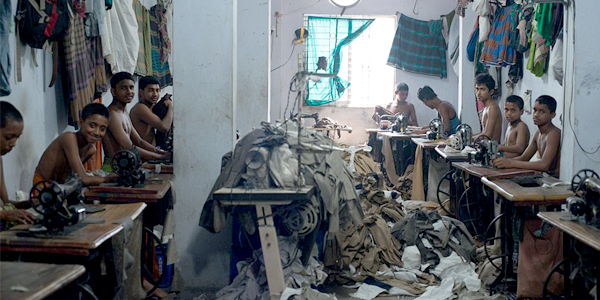
It appears that every society naturally takes children out the workplace when they are rich enough. It's not that parents, all throughout history, hated their children! They sent them to work because there was no viable alternative.
As world poverty continues to decline, things are going in the right direction. Child labour has declined by one third since 2000, from 246 million to 168 million children. It's not that we can do nothing in western nations to speed along this process either, in fact - with the political will - we can. Charity can help, but the primary necessity is to open up free trade with the poorest countries in the world. Removing trade barriers to buying their products would help lift millions out of poverty abroad and lower the cost of living for families on low incomes at home. The next step would be to use our influence to encourage those countries to open up their economies to foreign investment so that companies from all over the world would flood in, bringing technology, skills, and infrastructure while bidding up the price of wages. As adults are able to earn increasingly more they will be able to take their children out of work and into education where they belong.
A. S. 04-03-17
If you liked this article you may also learn from this related article on workplace safety.
It actually requires an advanced economy to ban children from working. Children had worked throughout all of history, long before the onset of the industrial revolution had them conspicuously running around factories. It was a given fact of life because every pair of hands was needed to provide for a family, so they worked on the farm. As soon as Western economies were rich enough that parents could provide for their children without sending them to work they sent them to school instead. In the mind-nineteenth century before there was any mandatory education in the UK, 95% of children in Great Britain already had at least 5 and often as many as 7 years of education.
Further empirical evidence was recently provided, all to sadly, in Bangladesh where they tried to ban child labour prematurely only to find (as Oxfam reported) that the results were horrific. The kids went into prostitution, destitution, begging, stealing and starvation.
As world poverty continues to decline, things are going in the right direction. Child labour has declined by one third since 2000, from 246 million to 168 million children. It's not that we can do nothing in western nations to speed along this process either, in fact - with the political will - we can. Charity can help, but the primary necessity is to open up free trade with the poorest countries in the world. Removing trade barriers to buying their products would help lift millions out of poverty abroad and lower the cost of living for families on low incomes at home. The next step would be to use our influence to encourage those countries to open up their economies to foreign investment so that companies from all over the world would flood in, bringing technology, skills, and infrastructure while bidding up the price of wages. As adults are able to earn increasingly more they will be able to take their children out of work and into education where they belong.
A. S. 04-03-17
If you liked this article you may also learn from this related article on workplace safety.
Sunday, 12 March 2017
Why is the Capitalist Workplace so Authoritarian?
You are told that capital tyrannizes over labor. I do not deny that each one endeavors to draw the greatest possible advantage from his situation; but, in this sense, he realizes only that which is possible. Now, it is never more possible for capitalists to tyrannize over labor, than when they are scarce; for then it is they who make the law -- it is they who regulate the rate of sale. Never is this tyranny more impossible to them, than when they are abundant; for, in that case, it is labor which has the command.
- Frederic Bastiat, from Capital and Interest
A persistent criticism of capitalism as an ideology is that it is authoritarian by nature, and can only lead to tyrannical bosses ruling over dependent staff who are forced - by fear of poverty and starvation - to remain under their command. Certainly, if we take our example from the workplaces of today, most of them are hierarchical, and many of them pretty authoritarian. In extreme cases staff even need to ask permission to go to the bathroom. So there appears to be some demonstration to the thesis.
In reality there is nothing inherent in the system of free enterprise that necessitates hierarchy, and many businesses have been successfully run with decentralised structures. Ricardo Semler is an example of an entrepreneur who had such massive success running his business on a non-hierarchical model that he turned to teaching other capitalists all over the world to do the same. Nonetheless, crappy bosses who like to throw their weight around the shop or office are ten a penny, and since no one likes working under a dictatorship we really have to question why more egalitarian models not more common.
A market will tend to use the skills and propensities of the labour force within that market, because it is costly and time consuming to inculcate staff with new habits. For example, if a workplace can afford to hire experienced staff rather than train newbies they will often do so (especially where there is a high minimum wage.) Companies will sooner offer a raise to hold on to an employee with a good work ethic than take a risk on someone new. The fact is, human qualities are less malleable than other factors of production, and so it's usually going to be preferable to try and court the kind of employees you want around rather than try to foster whoever walks in the door into a new sort of character you like; especially considering people have their own proclivities and desires for their own personal character development, unlike machines. This is why most of the companies that run in cooperative or non-hierarchical structures begin with this idea as a primary value, and will tend to attract a certain kind of person who shares in the company vision and is competent to contribute to making it a reality. (Tim Kelley, an expert who currently helps companies adapt to what he calls "The New Paradigm in Business" states that as they do usually some number of employees flee, unable to adapt to the rights they are afforded, and responsibilities they must shoulder, under the changed system.)

Now am I saying that people are naturally slavish and therefore will tend towards hierarchy on a free market?
Not at all!
The average person who enters the workplace has been through 11-13 years of a mandatory education system which is highly authoritarian and hierarchical, and at the time in their life where their character is most impressionable and inclined to adapt to their circumstances. Their personalities have already been adapted to what was necessary for them thrive (or at least survive) under that system. Interestingly, the empirical evidence on how people best learn seems to suggest that a cooperative learning environment is far more productive than the isolated one that is the dish of the day at school. A crappy boss is not that unfamiliar in aspect from a crappy teacher, and it's hard to imagine that a population exposed to a long period of cooperative and mutually edifying education along the lines of the empirical evidence would be so tolerant of poor treatment from authority. If schools were to teach reasoning, social skills, emotional handing, conflict resolution, and other soft skills, far more people would have the skills to run organisations. start business enterprises, or create egalitarian ones.
The Marxist ideal of workers owning the means of production is perfectly compatible with free market capitalism, and there is no reason why there should not be more worker run cooperatives, communally owned business, and organisations with polycentric structures - other than the fact that currently, workers have no idea how to own the means of production or run a business. Partly because this requires different skills from what is required to complete their jobs from day to day, and partly because they are pre-conditions by years of hierarchical and authoritarian state education. If Marx was right and bosses provide no value - only skimming profit off the top - then workplaces without bosses will surely be more efficient and out-compete workplaces that shell out unnecessarily on paying them... but we will never know until we reform our education system.
Subscribe to:
Posts (Atom)