Showing posts with label economics. Show all posts

Monday, 26 July 2021

Human Irrationality is an Argument For – Not Against – Free Markets

If everyone was irrational all of the time we would be in big trouble. You’d never know when someone was suddenly going to swerve off the road for no apparent reason and drive into a building, or start babbling to you in tongues over the phone when all you wanted to do was order a pizza.[1]

That being said – people are irrational enough of the time, that behavioral economists are never done telling us that they are not suitable for a market economy and need regulations to “nudge” them in the right direction. They illustrate the point with examples such as the fact that if you want to motivate someone to run you are better giving them $105 dollars a week then fining them $15 a day every day they don’t run, than rewarding them with $15 a day every day they do run ~ even though these things essentially amount to the same thing. So, naturally, we need policymakers to save us from ourselves and make us do the right thing. The irony of this position is that it presupposes that people are rational enough to respond to the incentives the behavioral economists want to mete out to them. Meanwhile, entrepreneurs have been doing more to devise apps that interphase with human psychology and help them adopt better habits than governments ever have! After all, it was the market that gave us Fitbit, mindfulness apps, nicotine gum, calendar apps with build in alarms to make sure we don’t forget appointments; the list goes on and is ever increasing.

For the main part, the market is what defends us against the consequences of the irrationality of others. I will define, for our purposes, rational as: having and acting upon beliefs that are in accordance with reality.[2]

If someone was irrational at all times in all respects, they could not meet the demands of life or sustain themselves, therefore they would either be dead, under the care of others, in a mental institution, or in prison. So, while no one is rational all the time, most people are at least rational enough of the time to exist within a society.

The great thing about the market is, as far as we are concerned, others only need to be rational upon the basis we deal with them. My mechanic might be a raving lunatic who drives his wife up the wall (no pun intended) with his crazy theories about the flat earth and interdimensional big foot people when he is at home, but so long as he is rational when it comes to the operations of fixing my car, it need not be any concern of mine. The pizza delivery guy could have views on race that most people find abhorrent, and I would never even know so long as he delivered it on time! The architect hired to design a bridge for a new highway might be a fanatical communist who thinks all property should be publicly owned, but as long as he is rational enough to follow the laws of physics when it comes to the blueprints, the bridge won’t be built upside down and will not collapse under the weight of the vehicles crossing over it. No one is remunerated on the market for doing irrational things, for example, bringing Squid Waffles to market. No one is interested in buying or eating Squid Waffles. Therefore, they don’t exist.

Now, need I point out, that none of this is the case when it comes to the alternative to the market, which is the political process. All of a sudden everyone’s crazy, irrational views that were none of my business become very real problems to me, because they are going to entre the voting booth and try and model a society that is fashioned based upon them. Someone might even lobby for a government subsidy to open up the first ever Squid Waffles diner! Sound crazy? Well how come the government both subsidizes and taxes tobacco at the same time? This is seemingly “irrational” but it makes sense when you understand that one lobbying block wants tobacco farmers to remain in business, and another wants people to smoke less.

While people’s performance on the market is tied to their rationality, ie., the fact that their views conform to reality and therefore they can deliver the desired results, there is no such failsafe at the ballot box. In fact, as the public choice theorists have been pointing out to us, it’s rational for voters to be ignorant about abstract topics like economics, political science, sociology, statecraft and basically anything necessary to cast a good vote, because learning the facts is time consuming and costly with very few payoffs.[3]

Typically, when you go into the world with irrational views that affect your day-to-day life you will be met with negative consequences. If you have irrational views about eating, you will get sick; if you have irrational views about how to treat your spouse, you will have unpleasant arguments or even a divorce; if you have irrational views about how to run a business, you will soon go bankrupt. In other words – reality provides a corrective against irrational views, or at least tries to!

The dirty secret about government is that replacing the market with its “democratic” control – be it public institutions or regulations – ends up removing this corrective mechanism and encouraging irrational behavior. No one wants to suffer the negative consequences of their own irrational behavior, whether it be an illness resulting from not having taken care of their health, or having a child they can’t support, or setting up a business to sell a line of products for which there is no demand. But democracy is inherently a system where people can make bad decisions and then vote to expropriate the consequences of those decisions to everyone else via the tax system. Those people who conform to reality by building products and providing services that meet the real needs of other people will essentially be punished for good behavior when the tax man comes around to expropriate their gains to pay for rent seekers and vagrants. This creates a tendency towards more costly, irrational behavior and less beneficial, rational behavior in society relative to what there would be on a free market. Over the long term, everyone will be disadvantaged on the whole, including those who seemingly profit from exporting the negative economic consequences of their actions to the body politic because the society they live in will be far less prosperous.


[1] I note that some economists, following Ludwig von Mises, take the position that people are always rational. What they mean by that is that all human behavior is goal-directed behavior and that when someone makes a choice they are choosing what they think will make them achieve that goal. (Mises: “A historian can say... In invading Poland Hitler and the Nazis made a mistake... All that another man can say about it is: I would have made a different choice.” – Theory and History) In my view that is a very specialized usage of the world rational, so I am going with the more commonly used understanding of the term.

[2] Please spare me debates about what reality is or how we know we can know it, Mr. Descartes.

[3] See, for example, Caplan, B. (2007) “The Myth of the Rational Voter.”

Thursday, 7 January 2021

Horizontal vs. Top-down Control

When I was growing up I got really into the "grand" global conspiracy. I went to see David Icke speak with my brother in a relatively small room in Stoke on Trent around 2002. There were only maybe a couple hundred people in the audience.


Later on, around 2007, I got really into economics and libertarianism. I began to think a less about the "global" conspiracy. Suddenly most of what I saw going on in society could be explained by economic incentives. 

For one thing, people like free stuff, of course they are going to vote it for themselves whenever they can. They don't typically see this as looting the commonweal, living at the expense of their neighbour, but "fair" in light of the challenges they face in life. Society has never told public sector workers, for example, that this is shameful, all is fair under democracy. A vote is a vote and a policy is a policy.

As a corollary, those individuals that make up government want power - even if it is power to "do good" according to their own values. One way the government can get power, while garnering the support of the populace, is to bribe people with handouts. People who receive benefits are from the state are likely to be supporters of the state. All the public servants, school teachers, university professors, campaign contributors, not to mention the politicians themselves, are basically bought off with public funds to be tacit allies of government. In addition to this, they keep an underclass on welfare, who can always be relied upon to support the institution of government out of fear of starvation. 

When our societies were not very affluent, only a small percentage of people's income could be appropriated in taxes because, say, a "0% reduction in the average person's living standards would have  been huge. As we have grown richer, the total tax many people pay is far in excess of half of their income. This allows the government to have a far greater number of people than ever before on its payrolls to protest tax increases, however, it does not cause the tax-payer themselves to starve. In addition to this, they believe they are at least in receipt of some services that have come to be seen as impossible to provide without government by the great majority of people, including roads, hospitals and schools. By this final act, the support of even the net tax-contributors are won over to the idea of government, and all of this is explainable merely by the incentives of the system itself. This is what you could more or less expect to happen in an affluent democracy. 

It's power being solidified, it's not difficult for the corporations, who deal with huge sums of money, to buy the government. In fact they are incentivised to do so. As soon as a corporation gains a greater return on their investment by lobbying the government than they do from serving their customer, that is what they are going to do. This completes the circle. 

Organisations like WHO, IMF, World Bank and CDC work in the interests of the corporations, but people think they are "government" agencies; which they take to mean working in the public interest.  

Now, this doesn't mean I don't believe individual conspiracies take place. For example, murder of Jeffrey Epstein. Other conspiracies such as The Lavon Affair or Operation Gladio are even freely admitted to have occurred. It just means that I don't necessarily think these need to be centrally orchestrated in smoky rooms by the same cabal of powermongers. 

The term conspiracy theory, itself, is simply used to dismiss claims out of hand and relieve people of the need for further investigation. The term "conspiracy theorist" is synonymous with "nut," and it is popular to psychologize people who believe in conspiracies as having some strange motive to find patterns where there are none. However, someone can have psychological tendencies which drive them towards a position - and that position can still be true! One of the appeals of the "conspiracy theorists" in the pre-YouTube world was exactly that they would bring context to a media landscape devoid of it, where the media would portray complex events as a snapshot in time. For example, propagandizing the populace with the claim that, "Saddam Hussein gassed the Kurds," without showing either of the videos of Donald Rumsfeld, then the defense secretary, meeting with Hussein in the 80s to sell him weapons.

Like many, recent events regarding the Global Pandemic (or "Globalist Plandemic" to conspiracy theorists), like many, have really made me think again of the global conspiracy again.

A global conspiracy, of course, could exist, and by its very nature of being secret and covert we would not even know about it.

My question though, remains, what is actually the scarier thought?

If there are just a handful of evil men who are orchestrating world event, up to no good, then it is relatively easy to depose them.

If it is not a centrally planned conspiracy then the world becomes far harder to fix. You have a nice neighbour, but he doesn't believe you should be able to operate a hair salon without a licence. Your drinking buddies want to take your guns. Your churchmates don't think gays should be allowed to get married. Another friend says Soviet Russia wasn't real communism and real communism has never been tried. All the people at your local theatre group support you being taxed to pay for allopathic medical treatments that you disagree with, taking money from you to pay big pharma. Atheists want Christians to pay for abortions. Meat eaters want vegans to pay for subsidies to dairy farmers. 

In other words - control is not exerted upon you vertically, from above, but horizontally, by the very people around you, whom you love.


Monday, 3 August 2020

Private Ownership of the Means of Production confers a Social Benefit

Perhaps the most difficult battle faced by the advocates of free markets it to convince people that Private Ownership of the Means of Production is not some special privilege conferring and advantage to "greedy capitalists" at the expense of everyone else, but that it serves a social function that is beneficial to all.

Private ownership makes the accumulated wealth of the entrepreneur a slave to the consumer - that is - to everyone else. We commonly understand private ownership to mean "for our own use," eg. the use of a toothbrush or a private residence, but in the case of private ownership, what is owned is almost exclusively for the use of others, placed at their service.

The capitalist keeps his wealth only to the extend he continues to use what he has accumulated in the interests of the masses, as they judge them, by churning out whichever goods and services they demand. To the extent he succeeds, his wealth will grow. This is the economy’s way of saying that he makes sure and wise decisions with the capital we have amassed as a society - not wasting them on projects that the public have no interest in paying for. To the extent he fails to do so, those factories, machines and companies that his investments represent will be sold on at knock-down rates to whoever thinks they can do a better job of managing them in the public interest. This allows for the constant re-allocation of capital to those who can best manage it, and engenders the accumulation of more capital over time. As the capital stock increase there is more wealth generation and technological advancement can be expected, and this will necessarily be largely led by the preferences of consumers, not those who actually "own" the capital.

Thursday, 5 July 2018

The NHS is a False Prophet

According to a recent article in The Guardian by Polly Toynbee, The NHS is our religion in the UK and that's why the conservative government can't destroy it. Of course, the Conservative government has never actually tried to destroy the NHS. They haven’t even reduced the amount spent on the NHS. They haven’t even halted increases in healthcare spending. The only thing they have done is reduced the rate at which spending is going to continue to increase.

Before the National Health Service was created in Great Britain, our nation was a world-leader with an unrivaled record in making major medical breakthroughs. People came from all over the globe to study medicine, and to be treated in the UKDr. John Snow proved that the source of cholera epidemics was the water supply in London. Edward Jenner pioneered a vaccine for smallpox in rural England, and Sir Almroth Wright one for typhoid. Sir Humphrey Davy, also a Briton, first suggested the use of nitrous oxide as an anaesthetic in 1800. Sir Joseph Lister pioneered the use of antiseptics in operations in 1865 using impure carbolic acid, saving countless people dying from infections after surgery. Alexander Flemming, the Scottish physician discovered Penicillin in one of the charitable hospitals in London in 1928. Howard Florey and Ernst Chain, brought it to fruition working in a laboratory in Oxford in 1941.1 Britain had established the best record in the world for achieving major medical advances and had just developed the landmark drug of the 20th century, as well as playing a leading role in 5 out of the 7 leading medical breakthroughs between 1750 and 1948 when the NHS was established.2 Britain is no longer a leader in medical advances. Despite its costliness, nepotism, and other flaws, America’s private system has taken the lead.

Image result for the nhs is our religion

Britain has less of the latest equipment and the old equipment is often being kept beyond the time when it is safe.3 If a private company was using out of date intensive care machines and x-ray machines, obsolete cancer care equipment, and operating tables over twenty years old – double their safe life span – the champions of the NHS would no doubt be clamouring for more government oversight and regulation. When government agencies are culpable, they are more or less given a pass on public outrage because they are perceived to be acting in the public interest rather than for profit.

In the UK we cannot compete with cancer survival rates in the US. A 2011 report demonstrated that the average cancer survival rate was 71.18% in the USA as compared to 54.48% in England.4 Our healthcare may be free at the point of service, but fewer of us survive it. It is costly in terms of lives. In fact, the BBC recently ran an article that reported “patients ‘dying in hospital corridors’.”5 In one month 300,000 patients were made to wait in emergency rooms for more than four hours before being seen, with thousands more suffering long waits in ambulances before even being allowed into the emergency room.

The sad reality is that in the UK or Canada people die waiting in line for what would be quick and routine medical treatments in the US. In Britain a shocking 4 million people languish on waiting lists according to official sources6 up from a 7 year high of 3.4 million in 2015 as reported by The Guardian, a left-leaning newspaper,7 and this in a population of scarcely over 65 million. At current trends this number is set to rise above 5 million in 2019 unless we do something to reverse them.8

In the UK you could turn up to an emergency room with an appendix about to burst and still be asked to wait overnight before they find you a bed. One patient reported that a lack of treatment rooms led hospital staff to examine her for gynaecological problem which had left her in severe pain and bleeding in a busy corridor, in full view of other patients. Such humiliating anecdotes could be dismissed as embarrassing one-offs were it not for the shocking fact that as many as 120 patients per day are being attended to in corridors and waiting rooms, in the public areas of hospitals, and some even dying prematurely as a result. In the first week of 2018, over 97% of NHS trusts in England were reporting levels of overcrowding so severe as to be “unsafe.”9

25% of British cardiac patients die waiting for treatment, and an investigation by a British newspaper found that delays in treatment for colon and lung cancer patients have been so long that 20% of cases were incurable by the time they finally received care.10 193,000 NHS patients a month wait beyond the target time of 18 weeks for surgery.11 According to the OECD Britain has the lowest number of doctors per thousand population in the advanced world.12 A chart displayed in James Bartholemew’s book The Welfare State We’re In in 20 documented that while only 1% of patients of patients in the USA had to wait over four months for surgery, while the number was 12% in Canada, 17% in Australia, 22% in New Zealand, and a shocking 33% in the UK.13

Where free-at-the-point-of-entry resources are limited older patients are viewed as a drag on the system – especially since they require the most frequent care which costs much more. The average 65-year-old costs the NHS 2.5 times more than the average 30-year-old. An 85-year-old costs more than five times as much.14 Although a third of all diagnosed cancers in the UK are found in patients seventy-five and over, only one in fifty lung cancer patients over seventy-five receives surgery, and the NHS does not even provide cancer screening to patients over the age of sixty-five.15

The government can make waiting lists look shorter by denying patients services outright because those who have been refused services will no longer appear in statistics. If someone’s disease proves fatal because they failed to receive treatment in time, the government figures appear more cost effective because instead of having to budget for a series of expensive surgeries, they have a deceased person on their hands who will not rack up a whole lot of medical accounts. It’s not to say that anyone is perniciously trying to kill off patients, but with pressure constantly mounting for officials to show meaningful improvements, the incentive to coldly take advantage of manipulated statistics “for the greater cause of saving the NHS” will always loom. It is, after all, our religion. In one interview, prominent columnist Dr. Dalrymple reported “Managers going around the wards telling the doctors who they thought ought to be discharged. They had no medical training or knowledge. But they would try and influence the doctors to discharge patients quickly… This is a problem, of course, wherever the person paying for the care is not the patient himself… But where you have one giant organization that decides everything the hazard is even greater.”16

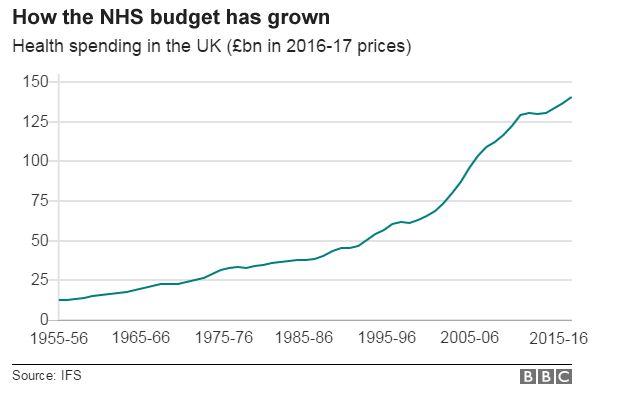
The failings of socialised medicine are invariably blamed on budget cuts and a lack of funding by advocated of the NHS who are used to expecting medical services to be paid for by the government. The assumption is that if we were just spending more money none of this would be happening. The thing is, we are spending more money than ever before already.

Image result for nhs budget has grown

In fact, the budget of the NHS doubled in real terms between 1995 and 201517 and now waiting lists are longer than ever! This is because the shortages and inferiority of services are not caused by a lack of funding in the first place. They are caused by how we are choosing to pay for healthcare.


If you are interested in receiving and advanced copy of my eBook Why Healthcare in America is so Expensive, please email me at frequency528@hotmail.co.uk to let me know.

1 Tooley, J. (2004, 2013) “The Welfare State We’re In” p106-109
2 Tooley, J. (2004, 2013) “The Welfare State We’re In” p109
3 Tooley, J. (2004, 2013) “The Welfare State We’re In” p131
5 Triggle, N. http://www.bbc.co.uk/news/health-42572116
6 https://fullfact.org/health/four-million-hospital-waiting-lists/
7 http://www.dailymail.co.uk/news/article-3158591/Hospital-waiting-lists-seven-year-high-3-4m-need-treatment-6-000-forced-wait-year-operations.html
9 Pickering, G. https://mises.org/wire/patients-are-%E2%80%9Cdying-corridors-britain%E2%80%99s-socialised-health-system
10 See DiLorenzo, T. J. (2016) “The Problem With Socialism” Chapter 9. p96-97
11 https://www.theguardian.com/society/2017/jan/13/193000-nhs-patients-a-month-waiting-beyond-target-for-surgery
12 http://www.dailymail.co.uk/news/article-2533698/Britain-just-2-71-doctors-1000-people-fewer-Latvia-Estonia-Lithuania.html
13 Bartholomew, J. P126
14 Triggle, N. (2017) "10 charts that show why the NHS is in trouble" BBC News, Health
15 See DiLorenzo, T. J. (2016) “The Problem With Socialism” Chapter 9. p101
16 Gunn, C. and Dr Olsson, P. R. (2015) "Wait Till It's Free." Gunn Productions LLC, Waco, Texas. p67
17 Author Unspecified (2015) “Health Spending”, The Institute for Fiscal Studies.

Tuesday, 5 December 2017

Can Government Make a Business Run "For The Good of Society" ?

The New York Post recently reported that a judge in Indiana has temporarily barred Starbucks from closing 77 Teavana stores that were failing because "the very profitable Starbucks could absorb the financial hit". Industry experts said the ruling will send a chill down the spines of distressed retailers, and with good reason! The prospect of not being able to shut down an outlet that is bleeding the rest of the business may have countless unintended consequences that will affect not just owners but consumers in general. Firms are likely to take this as a signal to be more cautious about opening up new stores, and become reluctant to invest, take risks, and employ people in the first place. Customers stand to lose.

Amidst the debate upon the justice of the justice in question, I heard a voice clamour, "The question is not of profit, but whether a business should be run for society or society should be run for business!" and to be quite frank the claim struck me at first as vacuous; professing much while saying very little. Yet we must admit that throughout history many governments have believed they were "serving society" (rather than the business community) by forcing companies to fix prices, continue operations at a loss, or even subsidising or bailing them out with public funds. Many have believed this is in the interest of "the greater good."

Could it be that government forcing Starbucks to maintain unprofitable stores - in some circumstances - would be good for society?

First we should examine the use of the word "society" itself. Rather than bring clarity, it obscures the issue, making it more difficult to apprehend the facts of the matter. Who exactly is society and how do we measure what is and isn't good for it? Society is made of a whole bunch of different individuals and groups with different interests, and what is good for one might not necessarily be good for another.

It's not that keeping a Teavana open despite the owner's desire to close it won't be good for anyone; clearly the proprietor of the shopping centres is willing to fight hard for what they stand to gain, and certainly regular patrons will be happy to be able to get their regular cup of chai before leaving a hard-days-shop. However, the point is the move privilege a few individuals who want to continue going to those outlets at the expense of everyone else in the area who has demonstrated that they would rather something else opens up in that space instead. Starbucks then will need to recuperate the loss somehow or other, perhaps by increasing prices slightly at all other locations. If the locality can only sustain the demand for three tea houses and the unprofitable Teavana happens to be the forth then they are also bleeding demand away from the other three, and so on. We can continue counting negative consequences to other parties.

If Starbucks are deprived of however many millions it costs to operate 77 unprofitable stores that is less money they have to invest in stores that are wanted by enough people to keep them afloat. It's less cash for shareholders who will take it out to the shops to spend it or reinvest it in other businesses, it's less for Starbucks customers who have to pay slightly more for a cup of coffee and therefore don't have to spend on something else, it's less for Starbucks employees who might have to forego a raise because there is less to go around..

Clearly the effect of this policy is not something that can be broken down into whether it ‘benefits society’ or not. All we can say is that it benefits some groups and harms others.

It seems ironic to me that most of those who will cheer on the judges ruling, forcing Starbucks to run 77 tea outlets - against their own interests - for the interests of others are probably the most likely to complain when a Teavana opens up that it will "drive out" locally owned tea houses (which are probably actually collapsing under the strain of the regulations they have to comply with, not being able to afford Starbucks team of expensive lawyers and accountants.) If anything you'd think this crowd would be cheering on the closures! As they carry with them a certain prejudice that whatever vexes big business is necessarily good for the rest of us, we can only conclude that supporting the ruling is less about what is good for society and more about what is bad for Starbucks.


Friday, 15 September 2017

Surplus Value

It's still a very prevalent view that employers are somehow exploiting the people who work for them when they draw a profit from their business, despite the fact that a person's employer is clearly doing more for their finances than all of the people who are not employing them. I might add, perhaps somewhat facetiously, including those keyboard-warriors who claiming that entering someone into employment is exploiting them.

It is true that workers do get paid less than the total value of what they produce, but that is because what they produce is made with other resources which have to be bought, and in a factory or work place which has a price and requires overheads to operate. The capitalist is responsible for paying for marketing and advertising to link the product to potential buyers - and at the end of the day, if the product doesn't sell, everyone else has already been paid but the capitalist walks away with the loss.

The capitalist lays out a vision of what he thinks will meet people's needs better than they are being met at present. This requires a particular expertise which is in itself a labour contribution over and above that of the other employees which is unique to the entrepreneur. If his vision is clear, indeed he will make a profit. If it is faulty he will make a loss. This is not a necessary risk, absent the profit motive a rich person is more likely to buy a bigger house or go on a cruise. But the capitalist takes a risk now, and foregoes consumption, in hope that he will reap the benefit later. That is part of what he is being paid for.

Another part of what he is being paid for is the time between making the investment and getting paid for that investment. We would all rather have resources in the here-and-now than some time in the future, because the future is uncertain, that is why lenders can charge interest on money that they borrow. They are choosing to forgo a smaller amount of consumption now for a larger one in future. The workers get paid now, the capitalist gets paid later only after the product has sold, and only IF it is sold, after everyone else has been paid. Austrian Economist, Eugen von Böhm-Bawerk explained that far from exploiting labour, the capitalist removes the burden of waiting for income from the workers. If they wanted to produce the goods themselves they would also have to wait until they could find a buyer before gaining a stable wage, and first save or borrow in order to accumulate the resources to buy a factory or workshop without the help of the capitalist.

Finally, it's worth mentioning that the capitalist is increasing the value of the workers labour! If a man decides to try out the same manoeuvres which might get them somewhere in a factory out in a field it will not produce much of value to anyone else. Clearly workers can earn more working for their employer than for themselves otherwise they would simply declare themselves self-employed and get on with making a higher income. Perhaps some of them can earn more working for themselves but do not want to take on the responsibilities entailed which are currently met by the firm which employs them. This too is evidence that capitalists are providing value.

Marxists hold that capitalists simply skim their profits off the top while providing no value of their own. That they are "extracting surplus value" from their workers. But if that was true, non-profit organisations would just swoop in and undercut profit-making firms by eliminating the "dead weight" costs of paying a capitalist. They do not because they cannot. Capitalists are clearly providing some competence or vision which benefits their workers. Each benefits from the mutual exchange, as evidence by the fact that if the worker could get a better deal s/he would take it, and if the employer could find a better worker s/he would hire them instead.

Ultimately, wages are not an arbitrary figure but a reflection of how much value an employee is able to provide to a customer. If a person wants to do away with an employer they can do so by learning skills, either on the job or on the side, which will allow them to work for themselves. Likewise, profits are not arbitrary but a reflection of how much value a company is providing on the marketplace. Provided - of course - that they are drawing their profits from serving the market place rather than lobbying or appealing to the state, but that is another article.


"In order to show that it is a half-truth, we must have recourse to long and dry dissertations."
- Frederic Bastiat

Thursday, 24 August 2017

Human Action for Beginners

The Austrian Economist Ludwig von Mises (1881-1973) authored his Magnum Opus Human Action (1949) in which he laid out his case for laissez-faire capitalism based on  a rational investigation of human decision-making. Mises, and the work by extension, is often maligned for "rejecting the scientific method" but this criticism is based on a lack of understanding of Mises' arguments. Admittedly, while few of his critics have read the man himself, Human Action was not exactly written with a lay audience in mind and so the basis of his ideas cannot be easily grasped at a glance. In the interests of clarity, allow me to make his case for him in my own words.

Mises did indeed attest that  the empirical method (positivism, or the scientific method) is not the correct methodology for reaching reliable conclusions on matters of economics. However, he did not reject the scientific method. He merely pointed out that the empirical method is ideal for matters of the natural sciences because when it comes to inanimate objects results are predictable. This is because the natural world is deterministic. Copper always melts at 1,085 °C. That which does not melt at 1,085 °C is not copper. Human beings, however, have differing values, tastes and information all of which strongly influence their decision making. Will a person buy a hamburger at half price? Certainly many more will than at full price, but for example I will not because I am a vegetarian, whereas some others may buy several times as many. It all depends on their individual ideas, expectations and preferences.

When it comes to matters of economics there is no way to set up an experiment and control for all factors as we can in a laboratory. We cannot, say, increase the minimum wage in one region to measure the effects on overall employment and compare it to the effects in another region where it is not increased, firstly because the implementation (or lack of it) in one region will also affect the behaviour of individuals in the other (some may move to take advantage of higher wages, others may stay to take advantage of cheaper labour costs.) Secondly because an economy is complicated, and thousands of other factors would also be at play in both regions which cannot possibly be controlled for. We cannot say (for example) that just because employment rose in one region after a minimum wage increase that this change was due to the minimum wage increase, only that it happened. Because we have no counter-factual there is no way to tell if employment would have increased even more if the minimum wage increase had not been enacted.

In light of this, Mises attested, a more suitable method of approaching economic questions would be necessary than the empirical one, based upon the foundation of certain axioms about human nature which could be reached by introspection (or thymology as Mises labelled it to distinguish from different uses of the term introspection.) In the interest of brevity and simplicity we only need to consider three of these; and I will explain why each should be uncontroversial.

The first is that humans act. This claim is hard to argue against because the very act of doing so would be to make a performative contradiction. The second is that when people act, they do so in order to substitute a state of affairs which they consider preferable for one they consider less preferable according to their own values. Again, I see no argument against it; if one is completely satisfied with their situation as it is they do not act but stop. Even the attempt at meditation or mindful acceptance of the present moment is based on the impulse to substitute a pleasant state of surrender to circumstances outside of ones control for a less pleasant state of resisting them. Finally, I add, that people respond to incentives. This axiomatically true because what people do not respond to can hardly be considered an incentive by the very definition of the word.

(To anticipate a potential objection I draw an analogy; a person might scold a dog for poor behaviour in the hope of stopping that behaviour, without realising they are reinforcing it because their dog enjoys negative attention better than no attention whatsoever. This does not mean that the master is failing to incentivise the dog; it just so happens that he is not incentivising the dog to do what he thinks he is.)

An acceptance of these three axioms (for which their is unlikely to be any disproof) reveals that it is incentives which guide economic decision making among individuals. This we all accept, if not in our conscious philosophy then by our actions. To illustrate with our earlier example of the half-price hamburger, the business owner offers this deal in the hope of selling more burgers by creating knowledge of his product. A person buying the burger at the lower price incentivises burger joints to offer burgers at a lower rate. (One might argue that not everyone will respond to incentives, illustrated by the fact that I will not buy the burger because I'm a vegetarian - but in fact in my case the incentive is simply not great enough to suit my values; were the price of the burger was -$10 [minus ten dollars] I might take the money and give the burger away to a homeless person.) Our policy-makers are often led by their unconscious acceptance of these axioms, for example, they may put a tax on alcohol do discourage its consumption, while placing a subsidy on a solar panel to encourage its use. These are not policies guided by the empirical method which is better suited to the natural sciences, but by the aprioristic understanding that humans act, and in their actions they respond to incentives. That is the method, named praxeology, which Ludwig von Mises advocated.


Wednesday, 23 August 2017

Slavery did not advance Western Civilisation.

Every now and then someone will say something like "Despite the fact that slavery was immoral the modern world was build upon slavery and we owe the lifestyle we enjoy to the sacrifice of slaves..." Sounds compelling - except its not true. Slavery held back the advance of civilization because its pointless to innovate, invent or automate when you have (free) slave labour. Absent slavery the agricultural revolution may have begun decades earlier. Slavery was an abomination, and positive ends can never become of corrupt means.


Sunday, 21 May 2017

If you're not growing you're dying.

It takes a long time to make changes in public institutions. You have to get enough of the public interested to make it an issue, you might need to get into the media which itself is a hell of a job and even if you do rouse some attention the best most people can hope for is to vote, and they need to vote for one of the package deals on offer. Even if your reform is quite modest and sensible and its benefit is uncontroversial, it may be adopted by a party who have several other ideas on your mind that you disagree with. There is another path, and that is to get a small concentrated number of people who already have a lot of influence to get on board with your ideal and push it through as a bill but even then the matter is not settled; it needs to go through levels of bureaucrats, managers and administrators before the change enters into the system at large and even then many employees will resist the change because they resent being told what to do by central planners.

If we take the example of our education system there has been no small amount of evidence on how to improve it since the 60s when a wave of intellectual idealists from the flower power generation began discussing how "getting things right" when it came to government could change the world. Some of this data has been around for over fifty years, some of it is still coming out. Have these reforms not been adopted for a lack of political will? Yes to a degree but also because of the insurmountable obstacles to mustering the political will. The largest is the simple fact that most people are more comfortable doing what they have always done than doing something new. Doing things differently is anxiety-provoking and it is very irritating to be told or forced to do it by an authority figure, even one who has the evidence on their side, when you think, "Well I have been on the front lines doing it this way my whole life, this is how I was taught to do it in four years of university I think you'll find I know how its done thank you very much you government busy body."

One of the reasons why markets are so important, and why products adapt to user preferences far quicker is because only one person needs to be bothered enough to accept a new innovation in order to force all the other providers in their sector to step up and do a better job. They can do that by matching the innovation, by implementing one that is equally valuable, by providing an inferior service but at a lower price, or in numerous other ways - but the fact is they have to step up and serve customers or on average over time they will be out of business. This means people don't even need to all be receiving the same service or a one-size-fits-all but it does mean that services that are way behind the times will fall out of favour. Public institutions are not under the same pressure to adapt to the times because people cannot divest from them easily since they are funded through the tax system rather than voluntary contributions that can be withdrawn if the service is poor, and also because they have a relative monopoly on the provision of services in their sector which means that people can't compare their performance to those of competitors who are trying different approaches which may have their own advantages or drawbacks.


People need to have a choice when it comes to services if the quality of services is to increase and not stagnate or fall behind the times. This is not because "ruthless tooth n' nail capitalist competition drives innovation" but simply without the petri-dish of trial and error which is a multitude of entrepreneurs with different information and ideas trying to sell them to a skeptical public there is really no way of discovering the best way of doing things. No one has all the answers, but many people have some of the answers, and by constantly turning over the soil society learns to combine the best ideas and discard the worst ones over time. The soil of government turns very very slowly and that's why innovation in the private sector continues (despite various government restrictions on who can innovate) while public institutions stagnate and become more expensive each year while providing poorer standards to the people.


Saturday, 22 April 2017

6 Reasons Why Healthcare is so Expensive in the USA

- In many states if you want to open a hospital you are obliged to go before an official board and demonstrate that the community needs this hospital and that you are willing and able to fund it all by yourself. The people on the board are going to be the big hospital administrators from already existing institutions who want the competition like a hole in the head.

- Nineteen states are even limited to having only a single medical school! There are only 123 in the US despite thousands of perfectly capable students being turned away every year because they can't find places.

- Not everything a doctor does requires 7 years of training but the law requires everyone to have at least 7 years of training to do it. (In some cases a practitioner will have to do 4 years of undergrad, 4 years of medical school, then 3 years residency by the end of which many are so burned out and seriously debt laden before they even begin their career.) The natural prescription is to allow doctors surgeries, clinics and hospitals to train and certify their own assistants to take responsibilities off the hands of highly specialised staff so that fully fledged professional can focus their time and attention on what they alone are capable of doing. Healthcare costs would plummet.

- In December 2011, the Administrator for the Centres for Medicare & Medicaid Services, Dr. Donald Berwick asserted (as he was leaving his job) that 20-30% of health care spending in the US is going to waste. He listed the five major causes as over-treatment, failure to coordinate care, the administrative complexity of the system, burdensome rules, and outright fraud.

- One study found that per capita prescription drug spending in the United States exceeds that in all other countries, $858 compared with an average of $400 for 19 other industrialized nations, and the most important factor allowing manufacturers to set high drug prices was market exclusivity, protected by monopoly rights awarded upon Food and Drug Administration approval and by patents.

- A Harvard Business Review analysis published in 2013 revealed that while the U.S. healthcare workforce grew by 75 percent between 1990 and 2012 a whopping 95% of the new employees were administrative staff rather than doctors or nurses meaning 19 administrative workers for every doctor. The Annals of Internal Medicine last year, observed 57 physicians found that 29 percent of total work time was spent talking with patients or other staff members and another 49 percent was spent on electronic record keeping and desk work.


I am writing a book called Why is Healthcare in America so Expensive if you want to get notified about it when it's ready download my last book for free.

Tuesday, 4 April 2017

The River: Public Policy or Private Responsibility?

What is common to many is least taken care of, for all men have
greater regard for what is their own than what they possess in
common with others. 
—Aristotle
The idea of aspects of the natural world being "privately owned" strikes as rather crass to most people and perhaps with some good reason as it brings to mind a vision of heartless mercenaries sacrificing nature to the pursuit of profit. Industrialists, we are led to believe, can only possibly view nature as a means to and end rather than an end in itself, and in doing so reduce it to a disposable commodity.

However, this prevailing assessment does not take into the equation the fact that true ownership is attended by responsibilities to which an owner must be held accountable. Where rights entail responsibilities (as they have in the past under common law), and these responsibilities are enforced, the claim to a property will serve naturally as an incentive to conserve that property. In effect owners will become custodians.*

* (The words "ownership" and "property" have perhaps simply taken on negative connotations synonymous with exploitation for various historical reasons, and so it is essential in order to dialogue on these topics that we make explicit the fact that our definition of ownership is one that not only entails property rights but property responsibilities.)

Most people presume that government must fulfill the role of protecting the natural world, but this arrangement throws up some rather dubious incentives. When governments write policy documents about rivers, lets say, they tend to be for the purpose of  delineating who is allowed to exploit the river, on what terms, and in what measure. Special favours can always be handed out to cronies or campaign contributors; to “stimulate local business”; or for any other political ends that might attract short term support for office-holders regardless of the long term consequences. The rights to log a forest can be sold off to the highest bidder and the tax payer can be left with the burden of restoring it to health.


Where the river (or forest) has particular ownership (rather than general ownership) it is fully in the interests of the owner (or owners) to keep it permanently in pristine condition for at least three reasons. (Owners also need not necessarily be private companies or individuals, but also charities, trusts, worker or consumer cooperatives, NGOs, or any form of organisation - that notwithstanding,  even if held by a private corporations these same incentives will apply.)


The first is in order to retain (or even increase) the resale value of the river. The better condition the river is kept in the higher its value will become; and even if the proprietor has no plans of ever selling the river they still have no interest in losing whatever outlay they have sunk into acquiring it in the first place. As such, a particular owner has the maximum incentive to protect against the river being polluted and to take whatever action is necessary to prevent it from being polluted. As a rightful owner they have the legal and moral right to take action against anyone who pollutes the river because the polluter has damaged the value of their property.  As it is not under general ownership where everyone has as much right to abuse it as anyone else does, the proprietor's interests are aligned with the interests of the natural world, thus he is risen to the level of a custodian. 

Secondly, a well-kept resource is renewable - it can turn a profit indefinitely. A badly-kept resource cannot. If a river is ill-kept the return on the investment for acquiring that resource will soon dry up (no pun intended.) As such an owner who does not know how to take care of the river will stand to gain more from passing it on to someone who does than from keeping it. A superior custodian will be able to pay more to acquire the river since they know how to put it to good use indefinitely.  The best experts in keeping a river running cleanly stand to gain the most from owning them and therefore will be able to pay more to acquire them than those who lack that expertise. In this way those who are the best custodians of resources will end up with them in their care on average over time. (The same would go for forests, fisheries, or grazing lands; where altruism is not enough to motivate environmental concern, rational self-interest will usually do the trick.)

Thirdly, if the river is not properly kept and becomes polluted, this is inevitably going to have negative effects on neighbouring lands, industries and settlements as the pollution is carried by the river onto other people’s property. At this point, as the last line of defence against irresponsible misuse and management of the river is the threat of litigation against the owner for his negligent and harmful management of his property. Where others have suffered harm, loss of health, or damage to their own property, a particular owner should be forced to pay damages and reparations to restore them to their original condition. They can lose their personal property and have to forfeit ownership of the river if they are found guilty of causing damages. When the government causes environmental catastrophes, as they often have, they can only be tried in their own courts, and even so the property of decision-makers is never at stake - even if found guilty of wrong-doing, the public purse will eventually foot the bill. As officials in public institutions tend to have a diffusion of responsibility it is hard to hold particular culprits to account for their actions, rarely will a department be shut down or replaced where abuses occur as they are presumed essential even having "made mistakes". Often state officials have sovereign immunity, occasionally one or two resignations will be tendered as a  token gesture, but the machinery of the institution remains as well as the lack of moral hazard which set it up to fail.

Saturday, 1 April 2017

Misanthropic Myths about 3rd World Poverty debunked!

One of the most persistent myths about 3rd World Poverty is that if underdeveloped nations are allowed economic advancement and become wealthy it will be some kind of unmitigated environmental disaster. Is that so?

Wealthy countries can afford to clean up their water supplies after fouling them and treat their sewage properly. They can replant their forests, put recycling infrastructure into place, and farm sustainably. Countries without wealth can’t do that. In places like Bangladesh people must scramble to make a living with no long-term consideration to their surrounding environment, and they have no means of repairing it afterwards. Starving Brazilians have little choice but to cut down the rainforest when they can hardly afford not to. A lack of a just legal system, economic freedom and property rights1 prevent some of the world’s poorest countries from diversifying their economies, leaving them to rely on the exploitation of natural resources to generate income. As these nations develop they attain the means to establish other sources of revenue that don’t simply involve digging things up and selling them.

As economic growth first sets in environmental degradation can worsen for a time but soon environmental health indicators (such as water and air pollution) tend to reduce.2 Environmental pollutants, such as sulfur dioxide, nitrogen oxide, lead, DDT, chlorofluorocarbons, sewage, and other chemicals previously released directly into the air or water are found in far lower levels.3 Once per capita income reaches about $4000 in a nation, people begin to demand a clean-up of their local streams and air. Among countries with a per capita GDP of at least $4,600, net deforestation has ceased to exist.4 Europe’s forests have grown by a third over the last 100 years.5

According to Hans Rosling, sustainable global development advocate, the richest billion people in the world are responsible for 50% of the world’s consumption of resources, the 2nd billion for the next 25%, and the third billion for the next 12.5%.6 This means that the 2 billion poorest people in the world could easily be raised to the standard of living of the 3rd or even 4th poorest with very little environmental impact at all.

Western Nations can help by establishing free trade with the world’s poorest countries and importing their produce in order to help their economies develop faster. Cheaper produce would also mean better living standards for people on low incomes at home. The protectionists argue that this would harm domestic farmers (who are already in receipt of considerable state benefits and government subsidies – some of which have been an environmental disaster7) but these farmers would not be starving should they have to migrate into other occupations – people in the third world are! They themselves could benefit from cheaper produce, and are we really expected to put the interests of a small group ahead of everyone else in the country and abroad?

Concerns for the environment regarding “food miles” (how far food has to travel) are also completely misplaced. It is often far more energy efficient to grow foodstuffs in countries with naturally high temperatures which would otherwise have to be artificially raised in colder climates. As Matt Ridley explains, only “4% of the lifetime emissions of food is involved in getting it from the farmer to the shops. Ten times as much carbon is emitted in refrigerating British food as in air-freighting it from abroad, and fifty times as much is emitted by the customer travelling to the shops.”8 Economist Johan Norberg also attests that while 83% of the CO2 emissions involved in American food consumption is used in the production phase, less than 11% is caused by transportation and that it's puzzlingly more environmentally friendly to grow apples in New Zealand and ship them all the way to Great Britain than to produce them locally.9

Some environmentalists believe that growing populations attaining greater living standards in developing countries is a recipe for ecological disaster, but actually birth rates fall to manageable levels only when countries become developed. The industrial revolution created population booms across the whole planet – but in every single country where a reasonable standard of living has been achieved population growth receded; there is no reason to believe that will be any different when it comes to the developing world. Education has played an increasing role and will continue to do so, while current projections predict that the world’s population will level off between 9 and 11 billion, and may even then start falling.

People who don’t have to scrape out a living can get educated, work less in agriculture, factories and more with their minds. Their occupations are not so polluting, and some of them may even be responsible for the environmental innovations of the future. Inventions such as e-mail and the USB Flash Drive have already saved more trees than all of the environmental activism throughout history combined, and a car today emits less pollution travelling at full speed then a parked car did in 1970 from leaks.10 It is clear that innovation is set to play an increasing role in the solution of our environmental issues. Intensive farming techniques have helped save countless acres of rainforest by increasing yields over less land, and soon lab-grown meat from cloned tissue may put an end to our factory farming crises by reducing the massive ecological impact of meat production through fossil fuel usage, animal methane, effluent waste, and water and land consumption. Cloned meat will also produce a positive impact on world health by eliminating the heavy use of antibiotics and preventing the fecal contamination which factory farming currently produces.

Countries where the vast majority of people are engaged in subsistence farming are a waste of millions of minds. They do not have the leisure time to enjoy art, become cultured, innovate, creative, and reach the higher potentials of human flourishing which will allow them to contribute to advances which may help everyone on the entire planet. They are too poor. Farming is of course a fine occupation too, but it should be chosen rather than forced upon people by poverty.

If we really believe in prosperity, we have to believe in it for everyone. Not just those lucky enough to be born into affluent nations. Fundamentally, it’s not economic progress but our irresponsible economic systems which are responsible for the environmental damage we have seen over the last 200 years. Governments can externalise the costs of damaging the environment and redistribute it to the taxpayer, rather than allowing producers and consumers who pollute to pay for the full cost of their choices. We can create sustainable economies by holding individuals and organisations personally responsible in proportion to how much they pollute. These very incentives would encourage people to choose sustainable development and ecofriendly habits far more of the time.


1 Where private property is established, logging companies develop the incentives to look after the sustainability and long term value of their land, and charities can even buy up tracts of land for preservation. At present that is rarely possible as those property claims would currently just be ignored by the loggers and the corrupt governments in those countries

2 Tierney, J. (2009). “The Richer-Is-Greener Curve.” New York Times.

3 Ridley, M. (2010). “The Rational Optimist.” Fourth Estate. p106

4 Waggoner, P. E. (2006) “Returning forests analyzed with the forest identity.” Proceedings of the National Academy of Sciences of the United States of America, vol. 103 no. 46.

5 Noack, R. (2014) “How Europe is greener now than 100 years ago.” Washington Post.

6 See BBC Documentary “Overpopulated” (2013) (available on youtube).

7 For example, the EEC – now the EU – tried a policy of buying everything that farmers produced and couldn’t sell which led to mountains of excess grain being produced that then had to be sold off at knock-down prices to third world countries, causing gluts in their markets which put local farmers out of business and had devastating effects on their economies. Before the policy was reverse countless miles of hedgerows well pulled up to make fields bigger uprooting the natural habitat of countless animals and insects giving way to the bleak, soulless prairies that parts of the UK have becoming. Magnificent wetlands were drained and destroyed to plant more land for crops that no one could sell 95% of the flower-rich meadows, 60% of the lowland heath, and 50% of ancient lowland woods were destroyed in little more than forty years in the UK alone.

8 Ridley, M. (2010). p41.

9 https://www.youtube.com/watch?v=_mBgUqqnsyw

10 Ridley, M. (2010). p17

Tuesday, 21 March 2017

Occupational Licensing

In 2015 Obama sent his council of economic advisers out on a fact finding missions to discover why job creation was so hard for the administration and this council - made up of a bunch of Democrats, right - not ideological free marketeers - concluded that demands for mandatory occupational licensing were creating terrible cartels, excluding workers and getting in the way of regular people wanting to start up businesses.

There are over 800 occupations that might require a licence in some states in America including a tour guide, manicurist, dog walker, librarian, locksmith, dry cleaner, auctioneer, fruit ripener, plumber, private investigator, Christmas tree vendor, florist, interior designer, funeral director, cab driver, shampoo specialist, glass installer, cat groomer, tree groomer, hunting guide, kick boxer, real estate agent, tattoo artist, nutritionist, acupuncturist, music therapist, yoga instructor and mortician.

On the back of people's justified fears of disastrous bridges being built by unqualified tradesmen and hapless patients being sliced open by quacks, government - with the help of protected industries - have managed to sell the myth that mandatory occupational licensing increases the safety and quality of services. People assume that if the government says its fixed its fixed. The reality is that mandatory occupational licensing far reduces the number of practitioners operating in any sector, and when consumers have less choice they have to take whatever they can get at whatever price they have to pay. As a result the quality of services can actually go down and prices up.

This is borne out by the empirical data:

After compiling a meta-analysis entitled, "Rule of Experts," S. David Young concluded “…most of the evidence suggests that licensing has, at best, a neutral effect on quality and may even cause harm to the consumers... The higher entry standards imposed by licensing laws reduce the supply of professional services…. The poor are net losers because the availability of low-cost service has been reduced.”

Stanley Gross of Indiana State University, had to concur, “…mainly the research refutes the claim that licensing protects the public.”

More recently economics PhD. Morris Kleiner released two publications (2006, 2013) for the Upjohn Institute for Employment Research demonstrating that licensing occupations does more to restrict competition that to ensure quality.

On a free market, the poor may have to sometimes settle for inferior services - but often that is better than no service at all which might be what they otherwise receive. Even so, the price of most services will come down over time if a multiplicity of firms are offering similar services: if not in price then in real terms as wages rise. There are more risks though. When people can’t buy services they might try to do their own work, their own electrical work, plumbing or dental work, this has often happened in the past, and sometimes the consequences can even be fatal.

Still, most people find it difficult to imagine how society might be protected from quacks without government-mandated occupational licences, so lets have a quick review of some of the market can account for this:

Market Competition. Consumers provide a large degree of regulation over markets by not repeatedly buying poor services and advising other customers of what to buy and what not to buy.
Consumer Watchdogs. Customers want to know which services offer the best value for money and are quick to consult experts in magazines or online for good information before they choose a provider.
Employer Discretion. Employers do not want to take on a poorly qualified civil engineer or plastic surgeon.
Registration. Third parties or groups of experienced practitioners can create registries of bonafide service providers. If a complaint is lodged against someone on the registry the administrators can investigate the case and strike them off if they are guilty or give them a warning.
Private Certification. In the absence of mandatory government licensing consumers will often want assurance from credible sources that the services they are going to pay for are of high quality - and more importantly - safe. Third parties can offer to certify practitioners that meet their standards.
Litigation. Customers already have protection under the law against faulty products or false advertising even in the absence of mandatory occupational licensing. The threat of being sued for causing damages is enough to deter most companies from releasing harmful products, if the threat of killing off their customers is not enough already.
Contracts. Customers can make explicit contacts with service providers to ensure they have recourse if they don't get what they think they are getting. If a company says the customer is getting x but gives them y the contract clearly delineates who is in the right and who is in the wrong.
Bonding. Individuals can engage in agreements in advance that involve third parties to ensure that payment is transferred when it is supposed to be.
Insurance. Customers can insure themselves against receiving faulty goods or receiving harm from services. In some cases the insurer will be able to bring litigation against the service providers for damages incurred offering a deterrent against providing poor services.
Jail. If the fact that it is not profitable in the long-term to kill of your customers is not enough to deter greedy capitalists from selling products that are physically harmful, the prospect of a jail term just might be.


Occupational Licensing simply come down to the government abolishing someone's right to provide services to someone else who is willing to buy those services, and then selling it back to that person at a fee. This is usually at the cost of several years in some educational institution where education in the necessary skills is dragged out over several years and supplemented with a whole bunch of written work that is superfluous to the exercising of those skills. The sum result of these policies are to drive otherwise capable people out of their passion because they are not academic, can't afford the education or the time off work, or can't look at another educational institution after the horrors of school. Willing students are saddled with debts and loss of work experience while they study and expect to recoup expenses from customers. All of this drives up the cost of products, reducing living standards for average people.


We see a real problem with this with the FDA when they allow highly dangerous foods - and people presume "the government has taken care of it, if it was dangerous it would be off the market" - when the opposite is the case. They have also held (and continue in some cases to hold) life-saving drugs off the market for decades at the expense of countless lives. They also have the monopoly on this service so it's impossible to compare their performance with any other agencies that might have had a much better record of making good judgements of food and drugs. With a multiplicity of firms acting in the sector you could compare their history for a sense of which might be the most reliable when it comes to what.